DCC Escape
Archived3D escape rooms that teach teenagers what to do in a crisis
Oct 2020 — Apr 2022
- React
- A-Frame
- Python
- PostgreSQL
- Client
- Distress Centre Calgary
- Team
- Team Houdini — four of us
- Launched
- February 2022
- Status
- No longer online
The problem
Distress Centre Calgary runs crisis support for Calgary and southern Alberta, including ConnecTeen, its youth program. Before COVID, the way they reached teenagers was to go into schools and give presentations.
The pandemic took that away, and moving the same presentation onto a video call did not work — not because the content was wrong, but because a slide deck over Zoom does not hold a teenager's attention. They needed something a sixteen-year-old would actually choose to finish. We partnered with them in October 2020 to build it.
An escape room, because nobody voluntarily reads a pamphlet
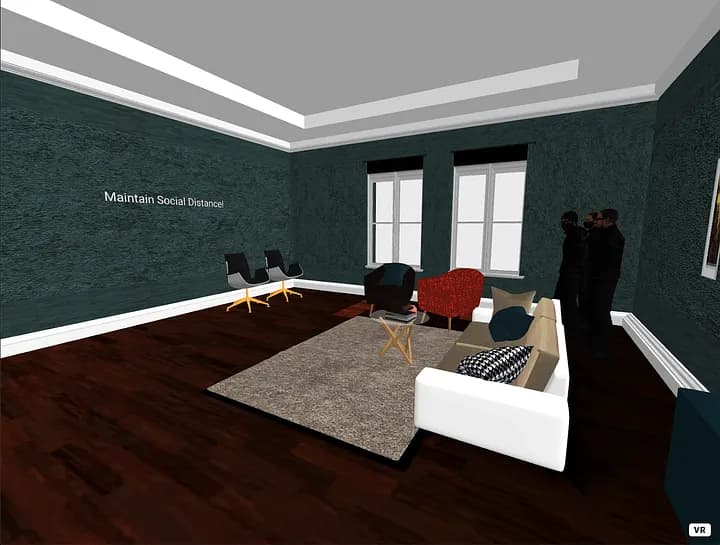
The product is a 3D escape room that runs in a browser. The mental-health content is not written alongside the puzzles; it is the puzzles.
The first room opens with you at a desk. There is a history paper due in a week that you have not started, and a biology lab, a math quiz and a chemistry exam all in the same week. The room begins to slant, your palms sweat, your heart beats faster. That is the puzzle: find a way out, and find help. The second room turns it around and puts you beside someone else in crisis.
That framing is the whole idea. Nobody clicks a link to read about crisis resources. They will play an escape room, and come out the other side having practised the thing the pamphlet would have told them.
Rooms, scenes, puzzles — and who can change them
The content model is three levels deep: an escape room holds one or more scenes, and a scene holds one or more interactable puzzles. That structure exists so the rooms can be rebuilt out of parts rather than hand-made one at a time.
The part that actually mattered to the client is the admin interface on top of it. Distress Centre staff sign in with their DCC email addresses and edit the rooms themselves — because crisis resources change, phone numbers change, programs get renamed, and a charity cannot file a ticket with four students who are about to graduate. Staff can also read the feedback students optionally leave after finishing a room.
Stack
React on the front end, Python behind it, PostgreSQL for storage. The 3D is A-Frame — the web framework for building VR scenes in the browser — using a forked build of its Inspector, A-Frame's visual scene editor, to do the scene-building.
The important consequence of that is where the content lives. Rooms, scenes and puzzles are rows rather than code, which is the only reason the admin interface can exist at all — a staff member changing a crisis phone number is editing data, not waiting on a developer to redeploy a build.
Eighteen months, in public
We prototyped the idea as Corona Escape at Hack the North 2020++ in January 2021, where it was one of the winning projects. That prototype was the argument that the technology would work at all.
From January to August 2021 we built the MVP with UW Blueprint, Waterloo's student-run nonprofit development group. We kept developing it through our final two terms. In September 2021 we soft-launched a single room flow, integrated into Distress Centre's own site on their subdomain. In February 2022 we launched properly with two flows, which Distress Centre pushed across their social channels with paid Facebook and Instagram placement behind it.
After we handed it over
The rooms ran well past our graduation. Distress Centre added a third one, Behind the Scenes at ConnecTeen, that we had nothing to do with — which was the point. We left them something they could extend without us.
It is not running today. Every route now answers with an API gateway error, though ConnecTeen's site still links to it. That is the ordinary end for a student project handed to a charity with no engineers on staff, and it seems better to say so than to keep a Play button pointed at a 403.